

Why Not a Red Frog?
On grief expression, agency, and clients with intellectual and developmental disabilities


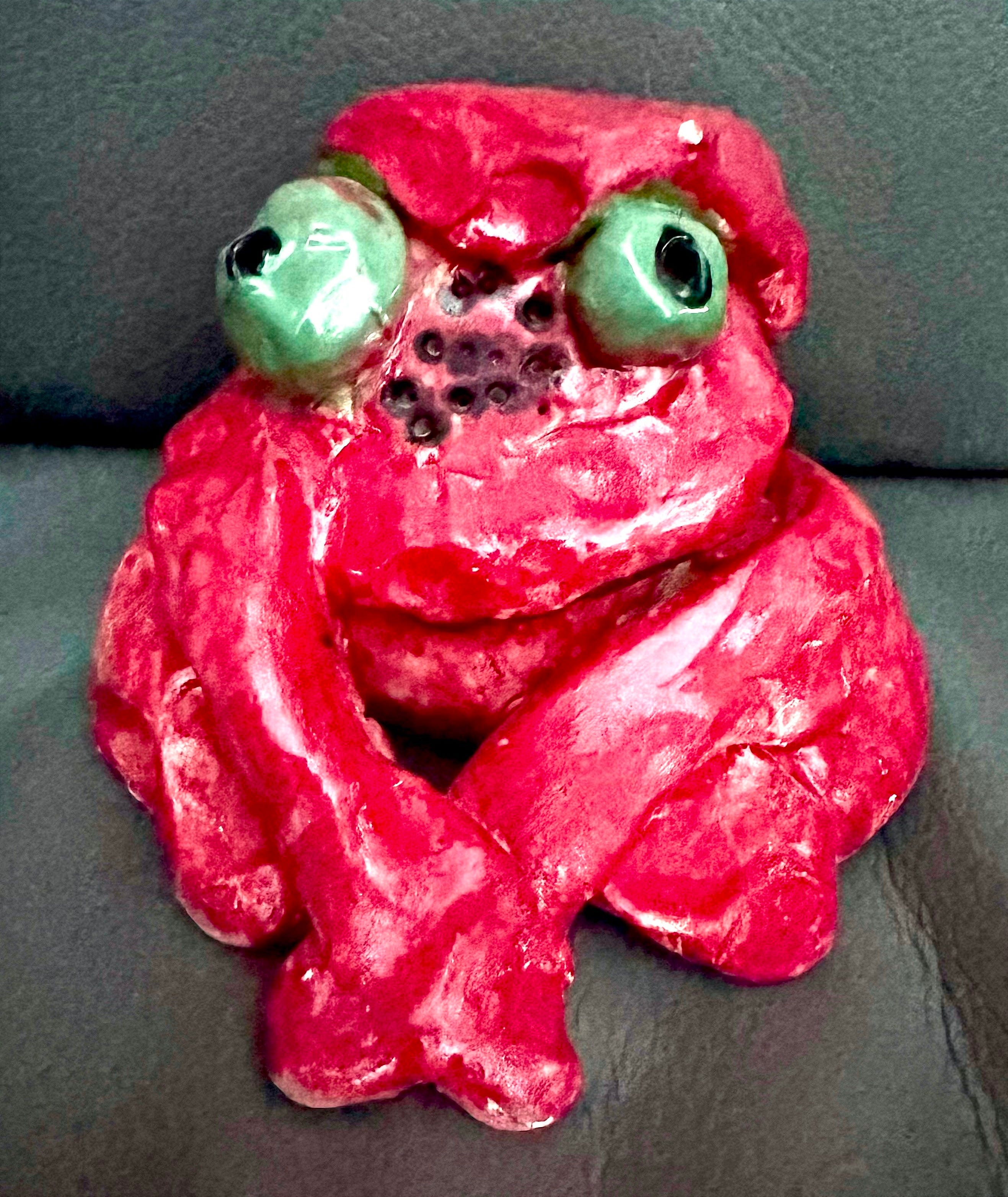
“Why is your frog red? Shouldn’t it be green?” my mother asked Drew.
My brother, who had Down syndrome, had just come home from art class and was proudly showing us his latest project. “No,” he said, insisting his frog should be red.
Lately, I’ve been thinking about red frogs. Who decided frogs must be green? Why do we feel pressure to conform to what’s considered normal or expected?
That same sense of expectation shows up in grief and loss. We’re supposed to cry, to feel sad, to miss the person, idea, or thing we’ve lost—and, after a while, we’re supposed to move on.
But what if our grief doesn’t look ‘normal’ to other people? Does that mean the loss hasn’t touched us? If my grief doesn’t look like yours, am I less sad—or simply sad differently? And isn’t it all still grief?
I’ve been sitting with these questions through The Compassionate Corner—an 8-week grief program I developed for individuals with intellectual or developmental disabilities (IDD). What I’ve learned is that grief can show up differently within the IDD community, particularly given the prevalence of complex or cumulative grief.
I’ve found that grief and loss in the IDD community can feel both different and deeper — shaped by a broader definition of what loss means, and by limited agency and opportunity to process it. It can also be challenging to express grief when differences in verbal expression, cognitive and emotional capacity, or physical health make communication harder.
In my experience, the greatest loss participants describe is a loss of autonomy—of the agency to choose how to live their lives. This grief, layered with other losses (employment, caregivers, peer groups, community, and more), can bring profound sadness and often frustration. Because grief can be expressed in many ways, it’s important to look for the root causes behind visible so-called negative behaviours.
Agency isn’t just a resource we need after loss; access to agency is shaped—and reshaped—across every area of a person’s life. It influences how someone sees themselves and what possibilities they believe are available to them.
This work has reminded me that the only normal is that there is no normal. One person’s grief will never mirror another’s. The only constant is that someone—or something—is missing.
For some, grief looks like overwhelming sadness or despair. For others, it may look like relief. For others still, it can show up as guilt. We’re often falsely taught that grief follows a predictable pattern and that, once you’ve moved through the well-known stages, you should return to normal. But with loss there is no return—everything has changed, and it stays changed.
Grief is personal. It belongs to the griever, and it is valid in whatever form it takes.
And yes, their frog might be red.
Reflective Prompts:
Is the visible grief the only loss the person is carrying? What other losses or past trauma might be making this grief feel bigger?
How is the grief showing up—confusion, acting up, pretending everything is fine, anger? I’ve seen each of these responses in participants.
How can you gently explore the root of the grief so you can better understand what the person needs—and how to support them?
How might acknowledging grief also be a way to support agency and build resilience in this population?
Marla Zapach is an alumna of the Creative Grief Studio and an End of Life Doula. You can learn more about her work and IDD related grief, loss, death and dying issues in the Hub on her website www.agoodtransition.com
For counselors, coaches, therapists, hospice workers, and other grief support practitioners who want to expand their toolkit, the Creative Grief Certification program teaches participants to create and use tools like this one in their own practice, grounded in creative, socially aware approaches to grief support. Enrollment for our next session is now open. Join us here.
 | A guest post by
|